Posts

Showing posts with the label open access

Summer Code Party at CfA

Image
On Saturday, we hosted an event at CfA as part of Mozilla's Webmaker campaign. It originally began as a continuation of the #OAHack that PLoS hosted (see post below) but the dates aligned and we were pleased to bring together the related ideas of the open web, open science and open access into one event. The Presentation John Wilbanks' started our day with a presentation explaining that if government is a platform, science is a wiki . In its current state, it's a terribly inefficient one, however. He shared some statistics on references to traditional versus open-published papers, such as the number and variety of citations resulting.  So why is science such a terribly inefficient wiki and what can we do to improve sharing, reuse, collaboration and ultimately progress? John Wilbanks Presenting First, open content. John noted the NIH's open access policy and how that's changed the playing field for scientists and in many ways for publishers too, although no ...
#OAHackday at PLoS

Image
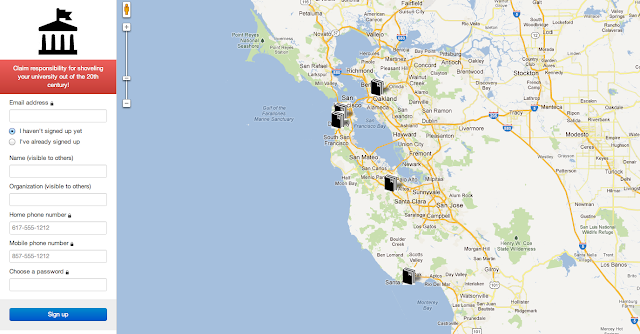
Yesterday, I attended a mini hackathon at PLoS in San Francisco to discuss strategies and work on tools to encourage the adoption of open access and shared content policies at research universities, publishers and elsewhere. We hope the event will be the first of many and plan to hold a larger, multi-day event in late June. While some focus on open access to scientific research, it's really part of the broader movement toward opening our entire culture, whether viewed through the lens of OER , Creative Commons , open source software or shared open data. Similar issues are back on the table in Congress with the re-introduced Federal Research Public Access Act (FRPAA), a bill that would require that taxpayer-funded research is made available to the public, similar to the NIH Public Access Policy . A competing bill in the House aimed at scrapping the NIH policy (to protect publisher's interests) led to a boycott of academic publisher Elsevier . The Right to Research Coalition i...

Section 508: Hiding in Plain Sight, and Boxes

A 21st Century Copyright Office Recently, Public Knowledge released a great report titled "A Copyright Office for the 21st Century, Recommendations to the new Register of Copyrights."   After a 16 year tenure as Register, and prior service at the Copyright Office, Marybeth Peters recently announced her retirement at the end of 2010 .  The Public Knowledge report provides a list of ten recommendations to the next Register in addition to commentary reflecting their necessity in light of technological revolution and technical possibility, the expanded policy role of the Office, and the legal basis and/or barriers to implementation of most of the suggestions.& The report provides just enough detail (for my taste!), excellent references and is not too long and technical.  I congratulate the authors on putting together a concise, accessible list of recommendations.  Highly recommended reading for those interested in these issues.  Below, I offer comments on a p...